
Myeloid NDC Assay
- U8002
-

1. Introduction
The Myeloid-NDC assay requires only 100ng of DNA to detect all the required genomic alterations.
Myeloid-NDC is a research use only assay intended for the integrated and qualitative detection of mutations, fusion genes/translocations and copy number variants from myeloid DNA samples.
The Myeloid-NDC assay has been designed as an integrated research tool covering most genomic alterations recommended for the genomic characterisation of acute myeloid leukaemias (AML), myelodysplastic syndromes (MDS) and myeloproliferative neoplasms (MPN)1-4. The Myeloid-NDC analysis application provides a simple solution to allow laboratories to perform integrated genomic research according to the newest guidelines and recommendations. The assay covers most genomic alterations recommended for the classification of acute myeloid leukaemias (ICC, WHO and ELN), myelodysplastic syndromes (IPSS-M, ICC, WHO) and myeloproliferative neoplasms (ICC, WHO).
Arber DA, Orazi A, Hasserjian RP, Borowitz MJ, Calvo KR, Kvasnicka HM, et al. International Consensus Classification of Myeloid Neoplasms and Acute Leukemias: integrating morphologic, clinical, and genomic data. Blood. 2022 Sep 15;140(11):1200-1228. doi: 10.1182/blood.2022015850. PMID: 35767897; PMCID: PMC9479031.
Döhner H, Wei AH, Appelbaum FR, Craddock C, DiNardo CD, Dombret H, et al. Diagnosis and management of AML in adults: 2022 recommendations from an international expert panel on behalf of the ELN. Blood. 2022 Sep 22;140(12):1345-1377. doi: 10.1182/blood.2022016867. PMID: 35797463.
Bernard E, Tuechler H, Greenberg PL, Hasserjian RP, Arango Ossa JE, Nannya Y, et al. Molecular International Prognostic Scoring System for myelodysplastic syndromes. NEJM Evid. 2022 doi: 10.1056/EVIDoa2200008.
Gerds AT, Gotlib J, Ali H, Bose P, Dunbar A, Elshoury A, et al. Myeloproliferative Neoplasms, Version 3.2022, NCCN Clinical Practice Guidelines in Oncology. J Natl Compr Canc Netw. 2022 Sep;20(9):1033-1062. doi: 10.6004/jnccn.2022.0046. PMID: 36075392.
2. Scope
Myeloid-NDC Assay Composition
| Gene Name | Region Covered |
|---|---|
| ABL1 | Exons 1-10 |
| ANKRD26 | Exon 1 |
| ARAF | Exons 4, 7, 10, 15 |
| ASXL1 | All coding |
| ASXL2 | Exons 9-12, 13 (partial) |
| ATG2B | Exon 1 |
| ATRX | Exons 5-35 |
| BCOR | All coding |
| BCORL1 | Exons 4-14 |
| BRAF | Exons 11, 12, 15 |
| CALR | Exons 8, 9 |
| CBL | Exons 4-9 |
| CBLB | Exons 8-17 |
| CCND2 | All coding |
| CCND3 | Exon 5 |
| CDKN1B | All coding |
| CDKN2A | All coding |
| CDKN2B | All coding |
| CEBPA | All coding |
| CHEK2 | Exons 2-14 |
| CREBBP | All coding |
| CSF3R | Exons 14-17 |
| CSNK1A1 | All coding |
| CTCF | Exons 3 (partial), 4-8 |
| CTNNA1 | Exons 6-17 |
| CUX1 | Exons 3-23 |
| DDX41 | All coding |
| DHX15 | Exons 2-5 |
| DIS3 | All coding |
| DNMT3A | Exons 4, 7-23 |
| EP300 | All coding |
| ERBB3 | Exons 3-8, 15, 22-24 |
| ETNK1 | Exon 3 |
| ETV6 | All coding |
| EZH2 | All coding |
| FBXW7 | All coding |
| FLT3 | Exons 11, 13-15, 16, 20 |
| GATA1 | All coding |
| GATA2 | All coding |
| GATA3 | Exon 6 |
| GNAS | All coding |
| GNB1 | Exons 5-6 |
| HRAS | Exons 2-4 |
| IDH1 | Exon 4 |
| IDH2 | Exon 4 |
| IKZF1 | All coding |
| JAK2 | Exons 8-19 |
| JAK3 | Exons 11-16, 21, 22 |
| KDM6A | All coding |
| KDR | Exons 11, 12, 23 |
| KIT | Exons 8-11, 13, 17-18 |
| KMT2A | Exons 6-26, 27 (partial) |
| KMT2C | Exons 1-21 |
| KMT2E | All coding |
| KRAS | Exons 2-4 |
| MAP2K1 | Exons 2-3 |
| MAP3K1 | Exons 14 (partial), 15-20 |
| MAPK1 | Exons 4, 7 |
| MBD4 | All coding |
| MGA | Exons 3, 9, 18 |
| MPL | Exons 10-12 |
| MST1 | Exons 7-14 |
| MYC | Exon 2 |
| NF1 | Exons 1-55 |
| NFE2 | All coding |
| NPM1 | Exons 4-7, 10, 11 |
| NRAS | Exons 2-4 |
| NSD1 | All coding |
| NUP98 | Exons 4-22 |
| PHF6 | All coding |
| PIK3CA | Exons 10, 21 |
| PIK3CD | Exons 9-11 |
| PML | Exon 6 |
| PPM1D | Exon 6 |
| PTPN11 | Exons 3, 8, 12-13 |
| RAD21 | All coding |
| RB1 | All coding |
| RIT1 | Exon 5 |
| RUNX1 | Exons 4-9 |
| RUNX1T1 | All coding |
| SAMD9 | Exon 3 |
| SAMD9L | Exon 5 |
| SETBP1 | Exon 4 |
| SF3B1 | Exons 13-18 |
| SH2B3 | Exons 2 (partial), 3-8 |
| SMC1A | All coding |
| SMC3 | Exons 3-25 |
| SRP72 | Exons 6, 10 |
| SRSF2 | Exon 1 |
| STAG2 | Exons 5-35 |
| STAT5B | Exons 14-16 |
| TERC | Exon 1 |
| TERT | All coding and promoter |
| TET2 | All coding |
| TP53 | Exons 2-10 |
| U2AF1 | Exons 2, 6 |
| UBA1 | Exon 3 |
| WT1 | Exons 1-9 |
| ZBTB7A | Exon 2 |
| ZRSR2 | Exons 2-11 |
| ABL1 | FLT3 | MNX1 | PDGFRB |
| BCR | FUS | MYH11 | PML |
| BRAF | GATA2 | NPM1 | RARA |
| CBF | GLIS2 | NTRK1 | RBM15 |
| CBFA2T3 | JAK2 | NUP214 | RUNX1 |
| DEK | KMT2A-PTD | NUP98 | RUNX1T1 |
| FGFR1 | KAT6A | PDGFRA |
| 5q | 7q22 | 8q | 17q |
| 5q31.2 | 7q36 | 12p | X |
| 7p | 8p | 17p13.1 | Y |
3. Output
Expected metrics
The table below shows the approximate expected metrics of the Myeloid-NDC assay based on 16 samples per hybridisation reaction (plus controls) and run on a NextSeq500/550 (Mid-Output 150 cycles cartridge) at 2 x 75bp. These can vary depending on DNA quality and quantity, technical factors in each laboratory, differences in equipment, performance of libraries, etc.
| Parameter | Expected value |
|---|---|
| Library yield (ng) | 3,000 (range: 1,000-6,000) |
| Library average fragment size (bp) | 330 (range: 275-450) |
| Average on/near target bases (%) | 80% (range: 70%-85%) |
| Duplicate reads (%) | 25% (range: 15%-35%) |
| Mean target unique coverage (reads) | 1,000x (range: 500x-1,500x) |
The following table represents the observed analytical performance for the Myeloid-NDC assay:
| Analytical Sensitivity | Analytical Specificity | Limit of Detection | |
|---|---|---|---|
| SV | >95% | >99% | 5% |
| VAR | >99% | >99% | 4% |
| CNV* | >95% | >97% | 40% (clonal cells) |
SV: structural variants, VAR: sequence variants, CNV: copy number variants. *The threshold baseline fold-change for deletions detected by Myeloid-NDC is 0.8 and 1.3 for losses and gains, and 0.7 and 2.0 for deletions and amplifications, respectively.
4. Resources
Myeloid-NDC resources
Myeloid-NDC Assay Quick Reference Guide
This quick reference document is intended to guide the users through the instructions of use for the Myeloid-NDC assay and associated laboratory procedures.
Myeloid-NDC Assay Analysis Guide
This document is intended to guide the users through the analysis of the results generated by the Myeloid-NDC assay and associated bioinformatics analysis application.

Myeloid-NDC NextSeq Sample Sheet Templates
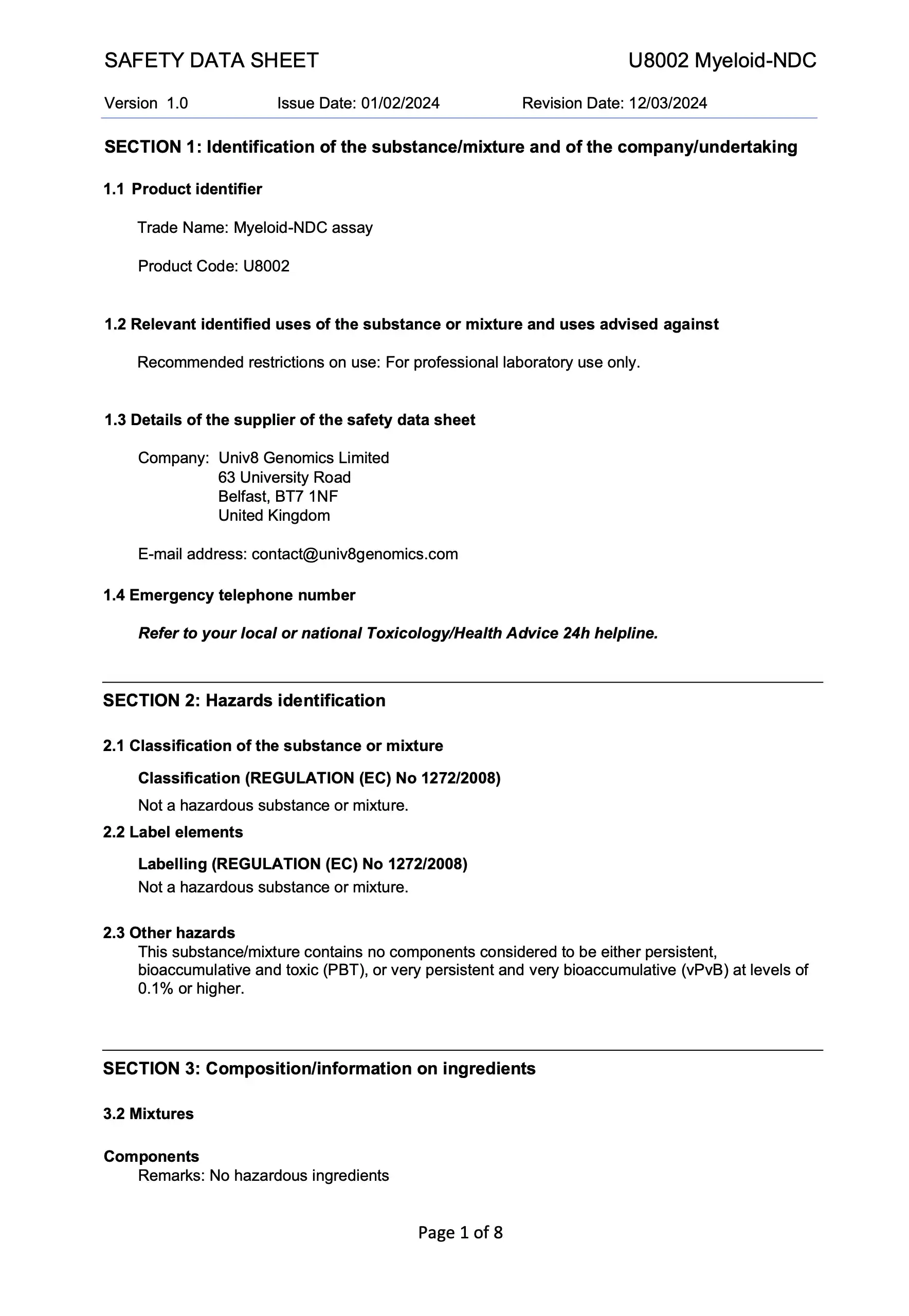
Myeloid-NDC Material Safety Data Sheet
Myeloid-NDC Demo Files
Examples of Myeloid-NDC output files from selected cell lines.
5. Enquire
Talk to our team
Please get in touch to request a quotation, more information about our products or simply to provide feedback. We’d love to hear from you.
For Research Use Only. Not for use in diagnostic procedures.