Skip to content

1. Introduction

The EuroClonality-NDC assay offers unparalleled testing efficiency combined with secure and integrated analysis.

  • Univ8 Genomics logo
  • EuroClonality logo

The EuroClonality-NDC is a capture-based targeted next generation sequencing (NGS) assay with customised bioinformatics pipeline for research use only, designed and developed by the EuroClonality-NGS working group (an independent subdivision of EuroClonality).

The EuroClonality-NDC assay has undergone a large multi-centre validation, performed across seven European laboratories, in a wide range of samples from more than 15 categories of lymphoid malignancies and including high molecular weight (HMW) and FFPE gDNA1.

These results highlight the robustness of the assay as performed in academic or clinical laboratories with varying degree of experience with DNA capture hybridization protocols.

In addition, EuroClonality-NDC can now be used in conjunction with our highly streamlined data analysis app. Powered by one of the most secure platforms for genomic data analysis (Illumina’s BioInsights and BaseSpace Sequence HubTM) the analysis process is set up to support our customers with security and data protection compliance.

References
1.

Stewart JP, Gazdova J, Darzentas N, Wren D, Proszek P, Fazio G, Songia S, Alcoceba M, Sarasquete ME, Villarese P, van der Klift MY, Heezen KC, McCafferty N, Pal K, Catherwood M, Kim CS, Srivastava S, Kroeze LI, Hodges E, Stamatopoulos K, Klapper W, Genuardi E, Ferrero S, van den Brand M, Cazzaniga G, Davi F, Sutton LA, Garcia-Sanz R, Groenen PJTA, Macintyre EA, Brüggemann M, Pott C, Langerak AW, Gonzalez D; EuroClonality-NGS Working Group. Validation of the EuroClonality-NGS DNA capture panel as an integrated genomic tool for lymphoproliferative disorders. Blood Adv. 2021 Aug 24;5(16):3188-3198. doi: 10.1182/bloodadvances.2020004056. PMID: 34424321.

2. Scope

EuroClonality-NDC Assay Composition

Gene NameRegion Covered
ABL1Exons 4-9
ARID1AAll coding
ASXL1Hotspot in last exon
ATMAll coding
B2MAll coding
BCL2All coding
BIRC3Exons 8 and 9
BRAFExons 11 and 15
BTG1All coding
BTKAll coding
CARD11Exons 2-16
CCND1Exon 1
CCND3Exon 5
CD79AExons 4 & 5
CD79BExons 4-6
CDKN2AAll coding
CDKN2BAll coding
CDKN2CAll coding
CKS1BAll coding
CREBBPExons 2-30
CXCR4Hotspot in exon 2
DIS3Exons 1-3 and 9-18
DNMT3AExons 8-23
EGR2Hotspot in exon 2
EP300All coding
ERGAll coding
EZH2Exons 15-17
FAT1All coding
FBXW7Exons 1-12
FOXO1Exon 1
H1-2All coding
H1-3All coding
H1-4All coding
H1-5All coding
ID3All coding
IDH1Exon 4
IDH2Exons 4 and 7
IKZF1Exons 2-7
IL7RExon 6
IRF4Exons 2-3
JAK1Exons 12-15
JAK2Exons 12-15
JAK3Exons 11-24
KITExons 9, 11, 13, 17 and 18
KLF2All coding
KMT2DAll coding
KRASExons 2, 3 & 4
MAP2K1Exons 1-8
MAP3K14All coding
MAPK1All coding
MEF2BExons 2-4
MYCAll coding
MYD88Exon 3-5
NFKBIEExon 1
NOTCH1Exons 26, 27 & 34
NOTCH2Exon 34
NRASExons 2-4
NT5C2Exons 9-15
PAX5All coding
PHF6All coding
PIK3CAExons 2, 5 10 & 21
PLCG1Exons 1, 11, 15-17, 19 and 29
PLCG2Exons 19, 20 & 24
POT1All coding
PTENAll coding
PTPRDAll coding
RHOAAll coding
RUNX1All coding
SAMHD1All coding
SF3B1Exons 12-17
SOCS1All coding
STAT3Exons 10-16 and 20-21
STAT5BExons 13-19
STAT6Exons 5, 9, 11, 12 and 14
TCF3All coding
TENT5CAll coding
TET2All coding
TNFAIP3All coding
TP53All coding
TRAF2All coding
TRAF3All coding
WT1All coding
XPO1Exons 15-16

3. Output

Expected metrics

The table below shows the approximate expected metrics of the EuroClonality-NDC assay based on 22 samples per hybridisation reaction (plus controls) and run on a NextSeq500/550 (Mid-Output 150 cycles cartridge) at 2 x 75bp. These can vary depending on DNA quality and quantity, technical factors in each laboratory, differences in equipment, etc.

ParameterExpected HMW-DNAExpected FFPE-DNA
Library yield (ng)3,000 ng (range: 500-6,000)3,000 ng (range: 500-6,000)
Library average fragment size (bp)330 bp (range: 275 – 450 bp)290 bp (range: 245 – 330 bp)
Average on/near target bases (%)80% (range: 70 - 85%)80% (range: 70 - 85%)
Duplicate reads (%)40% (range: 30 – 50%)40% (range: 30 – 50%)
Mean unique target coverage (reads)1,000x (range: 500 – 1,500x)1,000x (range: 500 – 1,500x)

This improved version of the EuroClonality-NDC assay and workflow underwent an analytical verification bridging study with gDNA extracted from 22 FFPE and 44 HMW samples which were included in the original validation study¹.

The following table represents the observed analytical performance:

Analytical SensitivityAnalytical SpecificityLimit of Detection
IG/TR Rearrangements>97%>97%5% VAF
Translocation>95%>99%5% VAF
SNV>99%>99%4% VAF
CNV*>95%>97%40%**

SNV: single nucleotide variant; CNV: copy number variation. *CNV have been validated in HMW-DNA for trisomy 12 and deletions of 11q, 13q and 17p. No performance data available for FFPE or other genomic regions. **Deletions can be detected if present in ≥ 40% of the cells. The threshold baseline fold-change for deletions detected by EuroClonality-NDC is 0.8 and 1.3 for losses and gains, and 0.7 and 2.0 for deletions and amplifications, respectively.

4. Performance

Performance specifications

The validation and performance characterisation of the EuroClonality-NDC was carried out on 280 samples comprising a range of different B and T cell malignancies using a different version of library preparation and hybridisation methodologies.

The EuroClonality-NDC assay and analysis workflow have been updated since to improve performance and target coverage. Overall performance of the EuroClonality-NDC assay was assessed by identifying underperforming regions using DNA extracted from a panel of 91 normal tissue samples. Regions were classed as underperforming if coverage was >2 standard deviations (SD) below the mean in ≥50% samples. Only 10 underperforming coding regions have been identified that could affect mutation detection in the genes and exons shown in the table below.

Gene NameChromosomeExon
ARID1Achr16
CARD11chr712
JAK2chr915
TRAF2chr91
PAX5chr910
STAT5Bchr1718
TCF3chr197
BTKchrX18
PHF6chrX6
PHF6chrX3

5. Publications

Publications related to EuroClonality-NDC

Comprehensive genetic analysis by targeted sequencing identifies risk factors and predicts patient outcome in Mantle Cell Lymphoma: results from the EU-MCL network trials

Type: Scientific Paper
Published: September 16, 2024

The authors demonstrate that applying the EuroClonality-NDC assay to DNA samples from peripheral blood and bone marrow reliably detects diagnostically and prognostically important genetic factors in MCL patients, facilitating genetic characterization in clinical routine.

Mutational and transcriptional landscape of pediatric B-cell precursor lymphoblastic lymphoma

Type: Scientific Paper
Published: July 4, 2024

Describes the molecular relationship between BCP-ALL and BCP-LBL using whole exome sequencing / transcriptomics. EuroClonality-NDC was used for IG/TR rearrangement analysis.

Large cell lymphoma through a liquid lens

Type: Commentary/Editorial
Published: May 30, 2024

Commentary/Editorial on the liquid biopsy manuscript below.

6. Resources

EuroClonality-NDC resources

EuroClonality-NDC Assay Quick Reference Guide

Release: r03, October 2026

This quick reference document is intended to guide the users through the instructions of use for the EuroClonality-NDC assay and associated laboratory procedures.

EuroClonality-NDC Assay Analysis Guide

Release: r03, October 2026

This document is intended to guide the users through the analysis of the results generated by the EuroClonality-NDC assay and associated analysis tools.

EuroClonality-NDC NextSeq Sample Sheet Templates

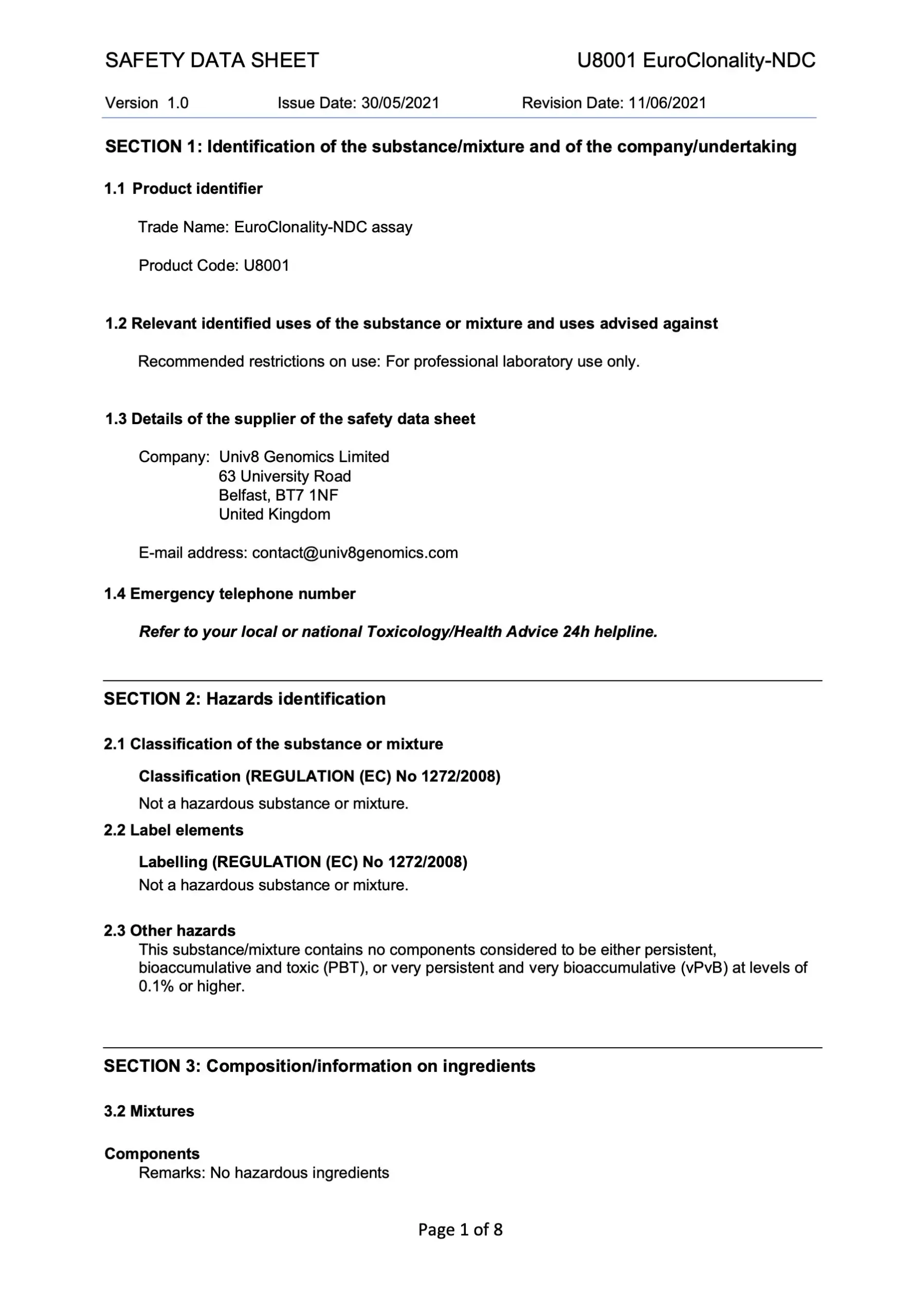
EuroClonality-NDC Material Safety Data Sheet

Release: June 2021

EuroClonality-NDC Demo Files


Examples of EuroClonality-NDC output files from selected cell lines.

Centres involved in the EuroClonality-NDC validation

Queen’s University Belfast

BELFAST, UK

Universitätsklinikum Schleswig-Holstein (UKSH)

KIEL, GERMANY

CEITEC – Central European Technology Institute

BRNO, CZECH REPUBLIC

The Royal Marsden NHS Trust

LONDON, UK

Centro Maria Letizia Verga

MONZA, ITALY

Hospital Universitario de Salamanca

SALAMANCA, SPAIN

Hopital Necker-Enfants Malades

PARIS, FRANCE

Erasmus MC, University Medical Center Rotterdam

ROTTERDAM, THE NETHERLANDS

Centre for Research and Technology Hellas

THESSALONIKI, GREECE

University of Torino

TORINO, ITALY

Radboud University Medical Centre Nijmegen

NIJMEGEN, THE NETHERLANDS

Hopital Pitié-Salpétrière

PARIS, FRANCE

7. Enquire

Talk to our team

Please get in touch to request a quotation, more information about our products or simply to provide feedback. We’d love to hear from you.

For Research Use Only. Not for use in diagnostic procedures.